
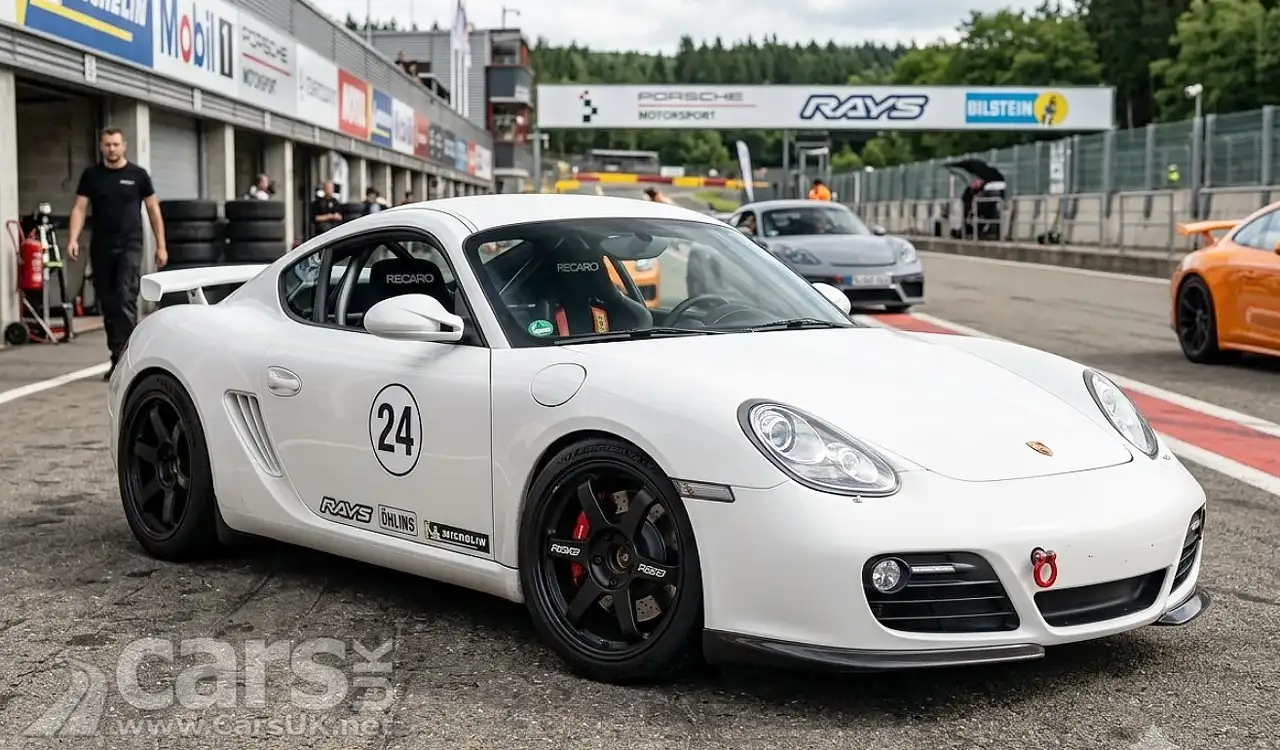
 Thanks to the Cayman’s nearly ideal mid-engine balance that flatters any driver on any surface, it’s one of the most popular Porsche models used for track days. It simply has everything well-packaged right from the factory (building many other cars to match this level would require quite a lot of parts and labour).
Though, those who have mastered a 987 or 981 to the point where factory capabilities top out don’t need to move up to the 911 series. The aftermarket is full of time-tested parts and upgrades that will elevate the performance of your Cayman for a fraction of the cost compared to the new car purchase. Below we’ll review the key components that will make your Cayman more effective at the track.
Spoilers & Diffusers
Aerodynamics is an area worth addressing when your track use becomes more intensive. It multiplies various forces with speed, which results in unloading or overloading certain parts of the car.
A front bumper lip or splitter reduces lift at the nose and adds front grip for sharper turn-in, while a rear diffuser cleans up the airflow underneath the car. Track wings improve downforce over the rear axle, loading it up for higher stability at speed and balancing the added front grip.
Browse bumper and trunk lips, racing wings, fenders, and body kits here to ballpark the cost and see what suits your particular Cayman build.
Braking Systems
Even though the factory brakes on the 1st and 2nd gen Cayman can handle canyon roads without complaint, under multiple track heat cycles they surrender fast. The OEM rotors are cross-drilled for extra ventilation, but those holes act as stress risers, potentially influencing the spider cracking that radiates outward once thermal loading turns severe.
Due to high stress at speed, the standard brake fluid often starts to boil under sustained load and pushes vapour into the brake lines, which kills pedal firmness and results in a long, soft travel exactly when you want to have a firm bite.
Two-piece drilled AND slotted rotors, such as those from Powerstop, address both issues. The rotor bolts to a separate aluminium hat that weighs less than a one-piece casting, which lowers unsprung and rotating mass. The slots clear gas and brake dust away from the pad contact area, and unlike drilled holes they do not weaken the disc. Specifically formulated track-compound pads with Carbon-Fiber/Metallic components work exceptionally well with a high-temperature DOT 4 fluid such as Motul RBF 660 or Castrol SRF (because pads really make no difference once the fluid boils).
Suspension
Due to the way stock suspension is designed, its geometry limits how much negative camber the front wheels can have. A standard 987 or 981 reaches only about -1.5 degrees at the front. For some situations, this is not enough because when the car leans in a corner, the tyre rolls onto its outer edge, so the outer shoulder carries most of the load. On R-compound tyres, that shoulder wears out quickly while the rest of the tread does little work.
Adjustable coilovers such as the KW V3 or Öhlins Road and Track allow compression and rebound damping to be set separately, so each can be tuned without changing the other. For camber, the usual fix is to fit Porsche GT3 two-piece lower control arms, or equivalents from Elephant Racing or Tarett Engineering. These arms accept shims that move the wheel outward and allow -2.5 to -3.0 degrees of front camber, which keeps the full width of the tyre in contact through a corner.
Exhaust and Performance
In a mid-engine car, the exhaust also affects how much heat stays in the tightly packed engine compartment. The factory headers have catalytic converters built directly into them, with often more than 400 cells sitting close to the engine. On the 987.1 in particular, sustained track heat can damage these converters, and it keeps a large heat source right next to the block.
Equal-length aftermarket headers with 200-cell high-flow sport cats, or cat-less headers on a cylinder to clear its exhaust gas faster, which lowers backpressure and reduces the heat held in the bay.
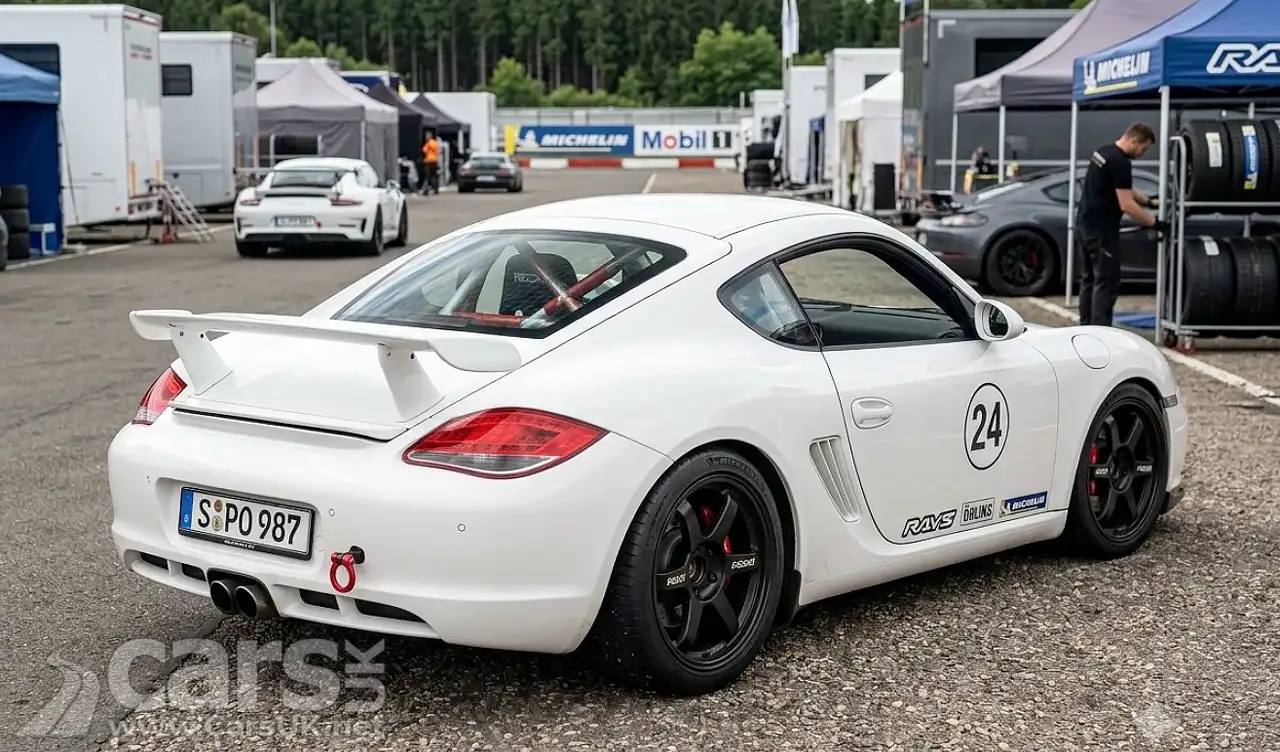 Lower backpressure improves mid-range torque, which is the range the Cayman relies on when accelerating out of a corner. Headers made from T304 stainless steel, Inconel, or titanium also weigh less than the heavy factory mufflers, which removes mass from a fairly high point in the car.
What to keep stock
Reliability matters more than outright performance on a track car, so some parts should stay original, and engine sensors are some of those components. Aftermarket MAF or oxygen sensors often send inaccurate readings, and when the engine control unit sees data outside its expected range it can switch to limp mode and cut power, which is dangerous at speed on a straight.
If cleaning no longer helps, then consider genuine replacement Bosch or Porsche sensors for anything the engine management depends on. Air filters follow the same reasoning. Oiled aftermarket filters can leave residue on the MAF sensor or even let more particles in and distort the readings. That’s why the standard OEM paper filter is often the right way to go.
Balancing the Build
A good Porsche Cayman 987 or 981 track build comes from fixing the specific weak points of the platform rather than adding as many parts as possible. The areas that matter are brake heat, front camber, and exhaust flow and heat, while the engine management should be left standard. Before your next track day, remove the wheels to check pad and rotor condition, and measure the current camber against the figures above. Our other 987 and 981 maintenance guides cover the related service work.

Have your say - leave a comment