
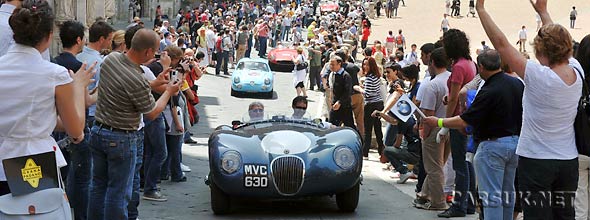
Jaguar has 6 works cars in the 2010 Mille Miglia
Jaguar has a total of 27 cars entered in this year’s Mille Miglia – including 6 works Jaguars – which takes place in Northern Italy next week.

Sadly no one really remembers that anymore, just the fact that the Mille Miglia is now a time-trial rally with no racing that attracts the cream of the now vintage cars that first raced in those 30 golden years (with a small, inconvenient break for some local difficulties between 1939 and 1945).
Jaguar has been around the Mille Miglia since the fifties and even had Stirling Moss as a works driver in 1951 (Stirling later went on to do the race in a Mercedes in 1955 – car #722. Now where have I heard of that?). And this year Jaguar are well and truly represented in the Mille Miglia with a total of 27 Jags running the 1,000 miles from Brescia in northern Italy.
And with this year being Jaguar’s 75th Anniversary the works team are a force to be reckoned with, with a total of six Jaguars from the Jaguar Heritage Museum taking part. This really is the best way to see proper classic cars as they should be seen – being driven and used properly, not hidden away in air-conditioned splendour.
Mike O’Driscoll – Jaguar MD – who will drive one of the C-Types this year said:
“The Mille Miglia is one of the world’s premier driving events, and one where Jaguar has always felt very much at home…Our association stretches back to the 1950s, when XK120 and XK140s were a regular sight and C-types and even a D-type also competed. This year I am proud to see another very strong contingent of classic Jaguars.”
He went on to say “Since our earliest days, we have been inspired to design and develop beautiful fast cars; cars that stand out and stand apart. I can think of nowhere better to continue our 75 year celebrations than at the legendary Mille Miglia, and I look forward to experiencing the unrivalled glamour, passion and motoring heritage that the event is certain to offer all competitors and spectators again this year.”
All a decent bit of publicity (Jaguar are one of the Mille Miglia sponsors this year and are supplying XFs as support cars), but that apart Mike’s not wrong. If you get the chance to go to Italy next week take it. The Mille Miglia is a glorious sight.
Some of the Jaguar Heritage Cars taking part in the 2010 Mille Miglia
1950 JAGUAR XK120 OPEN TWO-SEATER (Registration NUB 120)
NUB 120 was by far the most successful of the competition XK120s which, more than any other model, was the car that established Jaguar’s motor sport credentials. The vehicle was privately owned and campaigned by Ian Appleyard, with his wife Patricia (Sir William Lyons’ daughter) acting as navigator. After narrowly coming second in the first event he entered, the 1950 Tulip Rally in Holland, Appleyard then strung together an impressive run of victories including the Alpine Rally in 1950 and 1951, the 1951 RAC Rally, and the 1951 Tulip Rally. Despite failing to win the Alpine Rally outright in 1952, the third consecutive run without incurring a single penalty point earned the first ever Gold Cup for the car!
1953 JAGUAR C-TYPE (Registration NDU 289)
With its handsome wind-cheating aluminium body, the C-type brought Jaguar its first victory in the Le Mans 24-hour race in 1951. Two years later, the three factory cars finished first, second and fourth, with the winning vehicle driven by Rolt and Hamilton being the first ever to average over 100mph. One of 43 C-types sold to private owners, NDU 289 was a production car built in 1953. It competed in the 1953 Mille Miglia driven by its owner, the Italian driver Tadini, but retired during the race.
1956 JAGUAR D-TYPE ‘LONG NOSE’ (Registration 393 RW)
This vehicle was the penultimate D-type produced by Jaguar, built in March 1956 for the works racing team. That year, it won the Reims 12-hour race, driven by Duncan Hamilton and Ivor Bueb, before encountering technical problems during the 24-hour race at Le Mans, where it ultimately finished sixth (behind the winners Flockhart and Sanderson in another D-type entered by Ecurie Ecosse). Although Jaguar withdrew from racing later that year, the vehicle lived on in America with the Cunningham/Momo team, and finished third in the 12-hour race at Sebring in 1957. This vehicle remains one of the most original D-types in preservation, and still has the 1956 Le Mans windscreen, passenger seat and door, and even sports the original trade plate registration 393 RW.

Have your say - leave a comment