

2017 Tesla Model X 100D Reviewed
We’ve spent a weekend testing Tesla’s technologically-advanced all-electric luxury SUV – the Model X – in 100D spec. Does it make sense, or is it just plain ‘ludicrous’?

Since the US firm introduced the Model S in 2012, it has gone on to become one of the world’s best-selling luxury cars. The model brought us headline-grabbing and controversy-courting tech such as a 17-inch portrait-mounted touchscreen control system, Autopilot, and of course, ‘Ludicrous’ driving mode. In the first quarter of 2017 alone, 13,450 Model S’ found homes globally – impressive for a car with a median price tag of £91,000 from a company that only started making cars nine years ago.
Riding high on Model S’ deserved success, Tesla introduced its first SUV – the model X – in 2016, almost at the same time as the company announced it would introduce a new $35,000 entry level vehicle to its range, the Model 3. In the time since, Tesla has taken 518,000 $1,000 deposits on the car.
But before we can get sample what is to become Tesla’s most important, first truly mainstream model, we must familiarise ourselves with its most expensive, the Model X.
With a starting price of £70,500, rising to an eye-watering £128,250 for the 2.9-seconds-to-60mph-accelerating P100D model, it’s not cheap, and puts the model firmly in Range Rover territory. Our model is the mid-spec 100D model, which costs £87,200 and boasts the longest theoretical range of 351 miles, though realistically, you’ll achieve 280.
So what’s it like inside and out? How does it drive? And fundamentally, is it viable? Time to find out…
Inside and Out
 What’s most immediately striking about the Model X is its footprint. At 5,052mm long, the Model X is a gargantuan vehicle whichever way you look – it’s a full 51mm wider than an Audi Q7. Disappointingly, the Model X’s design is relatively anonymous when it’s not riding on 22-inch wheels. Only the flush-fit, brushed aluminum door releases – not handles – hint that the car is something altogether more futuristic than say, a Mercedes GLS.
All that changes at the press of one of the rear door releases though, when slowly, the Model X’s show-stopping ‘Falcon’ doors rise into the car’s roof, revealing two full-size, electrically-operated shell seats. These slide forward for access to a third row bench-seat. To that end, you can opt for five, six, or seven seats in a Model X, with the rearmost row folding flat into the boot-floor.
Up front, the dash and control layout is minimalistic. There’s no starter button nor anywhere in the dashboard to plug the key into; you simply press the footbrake, and the Model X awakes, closing the driver’s door automatically as it does.
The huge, 17-inch portrait-mounted screen which caused a sensation when it debuted on the Model S five years ago, is present in Model X, and operates in virtually the same, straightforward way. As you’d expect from a Tesla, there are some pub-chat-worthy features, such as ‘Bio-Weapon Defense Mode’ which creates a pressurised cabin environment – much like that of a jet plane. Handy, for when you’re trying to avoid chemical weapon attacks, or more pertinently, stop-start traffic smog.
The Model X, like its Model S sibling, is connected to its own 4G network. Customers can hook-up their home wi-fi to the car when it’s in range, and software updates – including the addition of new model features not fitted to the car at launch – can be downloaded and installed. It means that the tech for which Tesla’s models are famed, won’t date.
It’s a shame that the premium first impressions you get of the Model X from its Falcon doors, gloss-backed seats and ultra-responsive control screen, are spoiled slightly by the some of the other switchgear, and more pressingly, the build quality of some parts of the cabin. The electric window and door mirror switches for instance, are straight out of the Mercedes parts bin. Meanwhile, close one of the front doors with the window down, and the glass has a worrying tendency to move in its housing. Simply not good enough in a car costing upwards of £100,000.
There’s no shortage of space or storage though. The boot provides up to 2,180 litres of space, and an additional 187-litre front trunk makes the Model X one of the most practical luxury SUVs you can buy.
Performance on the road
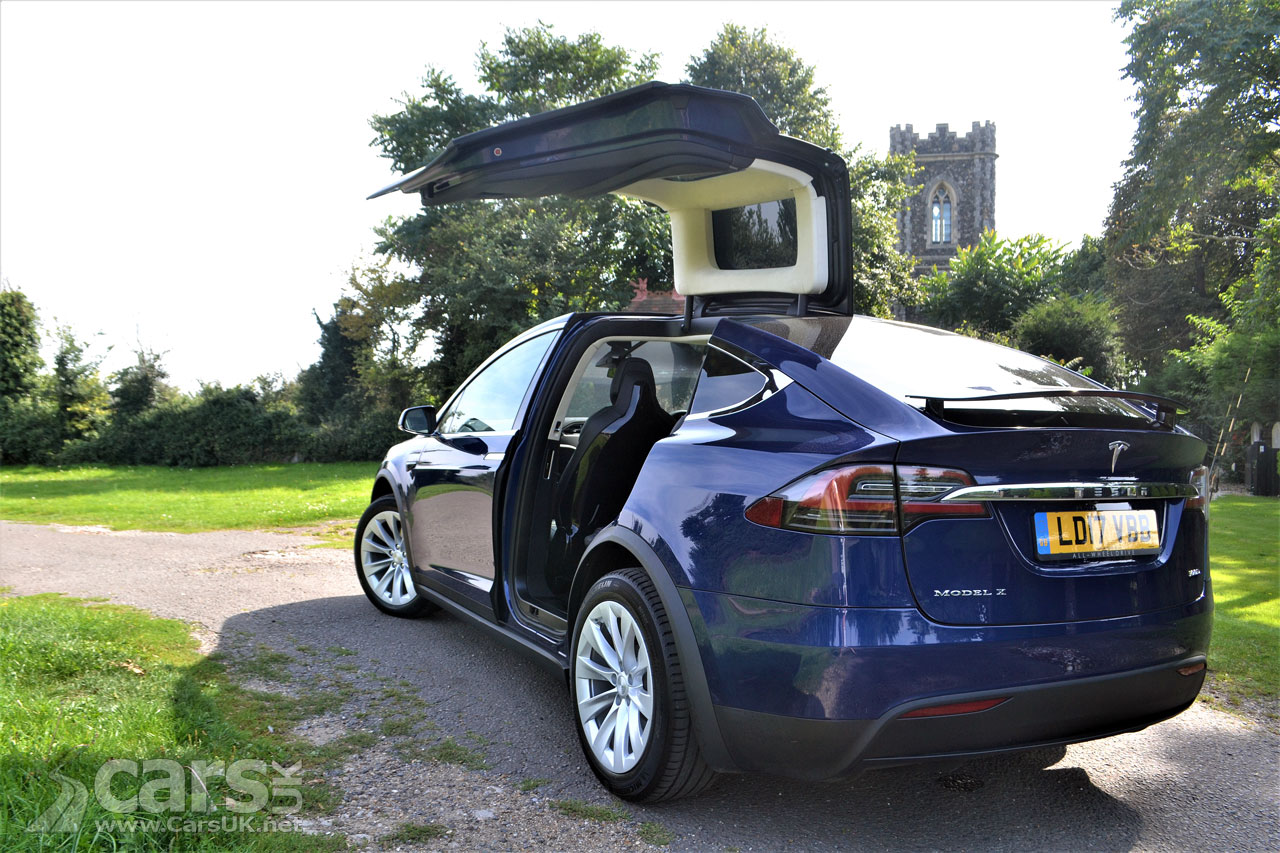 This is where the Model X truly excels. It’s a 2.5-tonne car, though from behind-the-wheel you’d never know. The steering is light, but avoids feeling artificial, while body control through even the tightest of country lane hairpins is stable.
The most impressive element of the Model X’s driving experience is of course the acceleration. It’s simply breathtaking. Our 100D model takes just 4.7-seconds to complete the 0-62mph sprint, and it feels even faster because the delivery of torque is instantaneous. Despite the pace, the driving experience around town and at motorway speed is impressively relaxing, with no engine noise to endure and a supple ride. Road noise at speeds above 60mph is the Model X’s weakness though, no doubt thanks to its large diameter wheels and tyres.
Forceful regenerative brakes are on hand to deal with all of the model’s power, and will bring you to a complete stop autonomously if the situation dictates.
And while we’re on the subject of autonomy; every Model X is fitted with collision avoidance and Enhanced Autopilot is available as an option. This includes traffic aware cruise control, Auto lane change, Auto park and Summon. Full self-driving is available as an option, but legislation currently blocks this from being engaged
One criticism that’s often levelled at the car’s massive touchscreen is that it can be distracting from behind-the-wheel. Fortunately, Tesla has thought of this, and all of the controls that drivers would typically need to access on a long journey can be controlled by two easy-to-use scrolls on the steering wheel. A single screen – not unlike Audi’s Virtual Cockpit – is positioned in front of the driver and displays traditional odometer and vehicle status information, as well as navigation and multimedia guidance.
Speaking of long journeys, the Model X, with its 280-290-mile real-world range will do them, but it’s hard to get over that feeling of range anxiety. That’s because a mile on the range indicator doesn’t necessarily mean a mile on the road. With charging stations still in woefully short supply outside of major cities, longer routes do require planning, though the act of charging car couldn’t be simpler. Simply connect the cables stored in the Model X’s boot to a public charger or three-pin, and affix the other end to the car’s charging port, which is neatly concealed behind a reflector in the offside rear light cluster.
You can also charge the car at one of Tesla’s destination chargers. There’s more than 1,000 of these in Europe. Better still, you can take advantage of a Tesla supercharger station and go from zero to 50% charge in 20 minutes. According to Tesla, most owners opt to have a wallbox installed in their garages for quick charging overnight.
Tesla Model X Verdict
 The Model X feels like a car that has been beamed across to us from 10 years into the future. In many ways that’s a great shame because it highlights just how unprepared we are for widespread vehicle electrification. And – putting aside for a second all of the fierce debates surrounding air quality and the oil running out – we should be, because the Model X deserves our attention.
Not only is the car practical, easy and quick to charge at home or on the go; it feels special, and functions in a way that is arguably much more familiar to us than combustion engine vehicles – via servers and the cloud.
Add to that, striking doors, a delicately balanced driving experience and the model’s ability to attract crowds and start lengthy conversations in supermarket car parks, and you have to conclude that the Model X lives up to the hype. It’s cabin quality isn’t up to scratch, but engage Bioweapon Defence Mode, and you’re left in no doubt what you’re paying for – the tech.
Now go and install a wallbox…
Tesla Model X 100D Tech Specs (2017)
- Engine: 100 kWh battery with AWD
- Performance: 0-62mph 4.7 seconds / Top speed 155mph
- Economy: 351 miles official range / 281 test
- Emissions: 0g/km
- Price: £87,200
- Test car supplied by Tesla UK

Have your say - leave a comment