
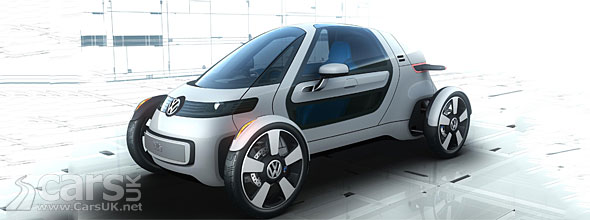
Volkswagen NILS Concept
Volkswagen has revealed the VW Nils, a single seat electric city commuter car due to debut at Frankfurt 2011.

We’ve been trying to think where this little fad for electric go-karts for commuters started. We think it might have been the Renault Twizy, but we’ve a feeling there’s something earlier. But never mind, the latest is from VW – the Volkswagen NILS.
The VW Nils – Volkswagen’s answer to Audi’s Urban Concept – looks like a flat-bottomed aluminium egg with a wheel on a stalk at each corner; gullwing doors letting you in to the shelter of the womb within. But just for one – no twins allowed in this womb.
The NILS (VW put in capital letters in the press release but not on the car – so we’ll mix and match) is made entirely from aluminium and weighs in at just 460kg. VW say it follows the pattern of an F1 car with an engine out back, room for one in the cockpit and a 17″ wheel at each corner.
Power comes from an electric motor behind the driver’s head producing a more than adequate 34bhp, enough to scoot to 60mph in under 11 seconds and on to 80mph, both of which will feel very quick in a vehicle the size of the NILS.
But your fun will be tempered by VW’s elf ‘n’ safety nannies if you try to squirt the NILS around town with the tail hanging out.
The NILS has been fitted with an automatic distance control which will keep you a pre-determined distance from whatever’s in front, and will even step on the brakes if it thinks you’re misbehaving. And not just step on the brakes, but actually bring you to a halt – ‘You vil drive as ve say you vil’.
But despite our antipathy towards electronic nannies, the NILS is a good direction for city cars. It takes up less room than almost anything else, there are no emissions at the point of use and it will be cheap to run.
But it probably won’t be cheap to buy. The Twizy costs £7k, and you can safely bet the NILS will be at least the same, if it ever sees the light of day.
Which is a barking amount of money for an electrified aluminium go-kart.
Volkswagen NILS Concept Photo Gallery
[nggallery id=758 template=customlinks]
(click thumbnail for full size version)
[EXPAND Click for VW NILS Concept Press Release]
NILS, a single-seat electric concept vehicle that offers a glimpse of a new form of minimalist mobility, has been unveiled ahead of its public debut at the Frankfurt Motor Show later this month. This concept car – which features an aluminium space frame, wing doors and free-standing wheels – has the dynamic performance of a sports car, yet travels silently, and with zero emissions.
The NILS project is supported by the German Federal Ministry of Transport, Building and Urban Development, and is designed to be both technically realistic and economically supportable.
‘NILS anticipates the future. The goal of the NILS project is to research a technically concrete and economically feasible vehicle concept for micromobility which restructures individual transportation to make it more efficient and environmentally compatible based on electric drive technology,’ said Dr Ulrich Hackenberg, member of the Board of Management and Head of Development for the Volkswagen Brand.
With a range of 65 kilometres (40 miles) and a top speed of 130 km/h (80 mph) NILS would be the ideal vehicle for the majority of commuters in Germany. According to the German Bureau of Statistics, 73.9 per cent of all commuters residing between Berlin and Munich cover less than 25 kilometres (15.5 miles) on their way to work.
Cars have always been mirrors of their times – their design styles and technological standards reflecting a particular era – and NILS is no different. It uses emissions-reducing electric drive technology to fulfil the specific requirements of commuters. In Germany, for example, about 60 per cent of all commuters travel by car, according to the Federal Bureau of Statistics; of these over 90 per cent travel alone. Zero-emissions vehicles like NILS will offer these frequent drivers a new eco-friendly mobility solution.
NILS is a very compact car that requires extremely little space in traffic. It is only 3.04 metres long – making it about 50 cm shorter than the new Volkswagen up! – just 0.39 metres wide from wheel to wheel, and a mere 1.2 metres tall.
NILS has the same basic layout as a Formula 1 race car, with the driver in the middle, the engine in back, and free-standing outboard wheels. The 17-inch alloy wheels are equipped with 115/80 (front) and 125/80 (rear) tyres optimised for low rolling resistance.
Though its inspiration may come from Formula 1, the styling has its origins at the Volkswagen Design Centre in Potsdam, Berlin. Designer Thomas Ingenlath, the centre’s director, said: ‘NILS was designed to make a visual statement and transport a vision of the automotive future to the present. I am especially pleased that we managed to implement the concept of the two glass wing doors. This allowed us to create large transparent surfaces and simultaneously to make entering and exiting the vehicle very comfortable, even in the most cramped of parking spaces.’
Because NILS is so compact and lightweight (460 kg), it is a lot of fun to drive. It has a top speed of 130 km/h, and can accelerate to 100 km/h in less than 11 seconds. This is achieved using an electric motor with a reasonably small 15 kW nominal power and short-term peak power of 25 kW. A lithium-ion battery supplies the electric motor with energy. The battery capacity (5.3 kWh) enables driving ranges of up to 65 km, depending on the style of driving. A battery of this size is relatively inexpensive, and can be charged either via a conventional 230-volt electrical outlet (maximum charging time two hours) or at an electric vehicle charging station. The socket is located at the back underneath the rear lighting module.
The centrepiece of the electric drive system is the lightweight 19 kg electric motor together with its transmission and battery. Energy management is via a high-voltage pulse inverter, which – together with the 12-Volt DC/DC converter for the vehicle electrical system and the charger – forms an integral drive unit. All drive unit components are located compactly in an aluminium housing at the rear of NILS; drive is to the rear wheels.
The motor, battery and all other components are so compact that there is still space for a small but practical bootspace. The body-coloured area above the rear lighting module swings upward, revealing space suitable for items such as a case of drinks and a bag.
Optimal weight distribution helps to ensure that NILS allows drivers not only to commute with zero emissions, but also to have fun while doing so. The lightweight NILS drives like a go-kart. The steering is purely mechanical (the low weight means power assistance is unnecessary), while the electric motor produces its maximum torque of 130 Nm from standstill, via a one-speed transmission. Suspension is by double wishbones front and rear; while ESP (Electronic Stabilisation Programme) helps to tame any over-exuberance on the part of the driver.
Safety is of course even more important than fun, and NILS is fitted with an automatic distance control system. This uses radar sensors to scan the space in front of the vehicle over a distance of about 200 metres and uses brake interventions to ensure that the distance to vehicles in traffic in front of the car does not drop below a specified minimum value. The system can even automatically brake the car to a stop, depending on the situation. Not only are the four disc brakes used to brake; electric traction by electric motor and battery regeneration can be used to brake as well. Last but not least, Front Assist is integrated in the automatic distance control system. This continually active system warns the driver of a potential collision; at speeds below 30 km/h (18 mph), automatic braking can avoid a collision under some circumstances.
The instrument cluster is a seven-inch TFT display. The vehicle’s speed is shown digitally in the middle, while energy flow is represented by bars. Another graphic display offers information on the driving range. The second central instrument is a mobile multifunctional device like the one used in the new up!: the Portable Infotainment Device (PID). It is snapped into theA-pillar to the right of the instrument cluster. Via touchscreen, the driver controls functions related to Navigation, Radio, Media, Telephone, Trip computer and – to preconfigure the driving range – ‘Eco. The PID computes the expected driving range, then it not only displays the route on the map display, but also the radius and thereby the destinations that can be reached using the current battery charge.
To save on weight and costs, certain functional elements and controls do without electrical assistance. The side mirrors, for example, are adjusted manually. The heating and ventilation system has full electronic control, and there is seat heating. Located to the right of the steering column is the motor start-stop switch; this round switch is also used to select D, N or R.
The aluminium space frame body was designed to be a highly effective safety cell. The body in white is produced from extruded aluminium, cast aluminium and sheet aluminium. The roof frame together with the door mounts, a roll bar, the bootspace and the front bulkhead consist of high-strength sheet aluminium. Extruded aluminium is used in the side sills, the transverse profiles and the front and rear car sections. The front and rear side body are aluminium. Parts made of high-strength plastic include the bumpers and the trim panels on the side sills.
The frames of the wing doors consist of three main elements: an inner section, a crash reinforcement section and an exterior part. When closed, they offer optimal crash safety. The door windows are made of lightweight, scratch-resistant, layered polycarbonate, while the front window is made of laminated safety glass.
The headlights are striking bi-xenon modules, while the indicator lights and daytime running lights are white and yellow LEDs. In the acrylic glass of the rear lights – integrated in the rear section like small wings – the light generated by LEDs is routed via transparent semiconductors which (appropriately for an electric vehicle) consume minimal amounts of power.
[/EXPAND]

Have your say - leave a comment