
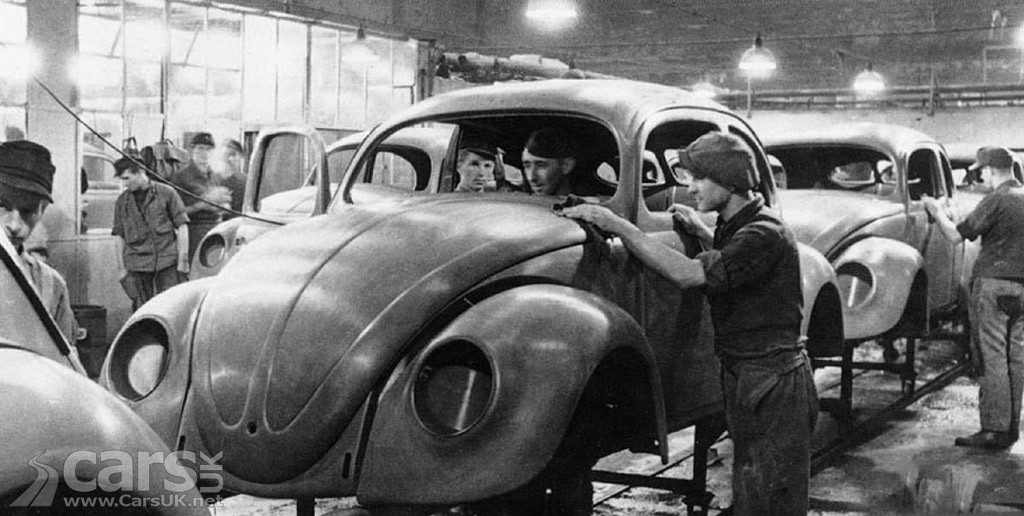
Volkswagen Beetle Production starts in 1945
This week marks 70 years since the first Volkswagen Beetle rolled off the production line in Wolfsburg, thanks to British Major Ivan Hirst.

Seventy years ago this week the first VW Beetles rolled off the production line in Wolfsburg, marking the start of VW as a world class company – and arguably the greatest car company in the world – and it’s all down to one man – British Army Major Ivan Hirst.
VW had been ready to build Hitler’s ‘Peoples Car’ – designed by Ferdinand Porsche – when war broke out, but efforts at Wolfsburg instead turned to repairing aircraft and making V1 flying bombs, using a workforce of 12,000 Russian POWs.
When the allies liberated Germany from the Nazis in 1945, Ivan Hirst – a Major with the Royal Electrical and Mechanical Engineers – was tasked with taking charge of the Wolfsburg Plant to see if anything could be salvaged.
But the plant had been bombed three times, there were no windows and the cellars were full of water. But much of the machinery was intact – with some stored in barns in the countryside – and after a quick Heath Robinson fix for the roof (using branches and tarpaulins), Ivan Hirst decided there were enough parts and machinery to start Beetle production.
He got an order for 20,000 cars for the occupying Allies to use, and production started on 27 December 1945, giving jobs to 6,000 German workers and laying the foundation for VW.
By the time Ivan Hirst gave up his task at VW in 1949, the new business had built 50,000 Beetles, established a dealer network and was exporting the Beetle.
The Volkswagen Beetle, and VW itself, may personify German enterprise and engineering, but without Major Hirst there probably wouldn’t be a Volkswagen at all.

Kim Dingh says
Slave labour was used and even a concentration camp was on the factory premises.